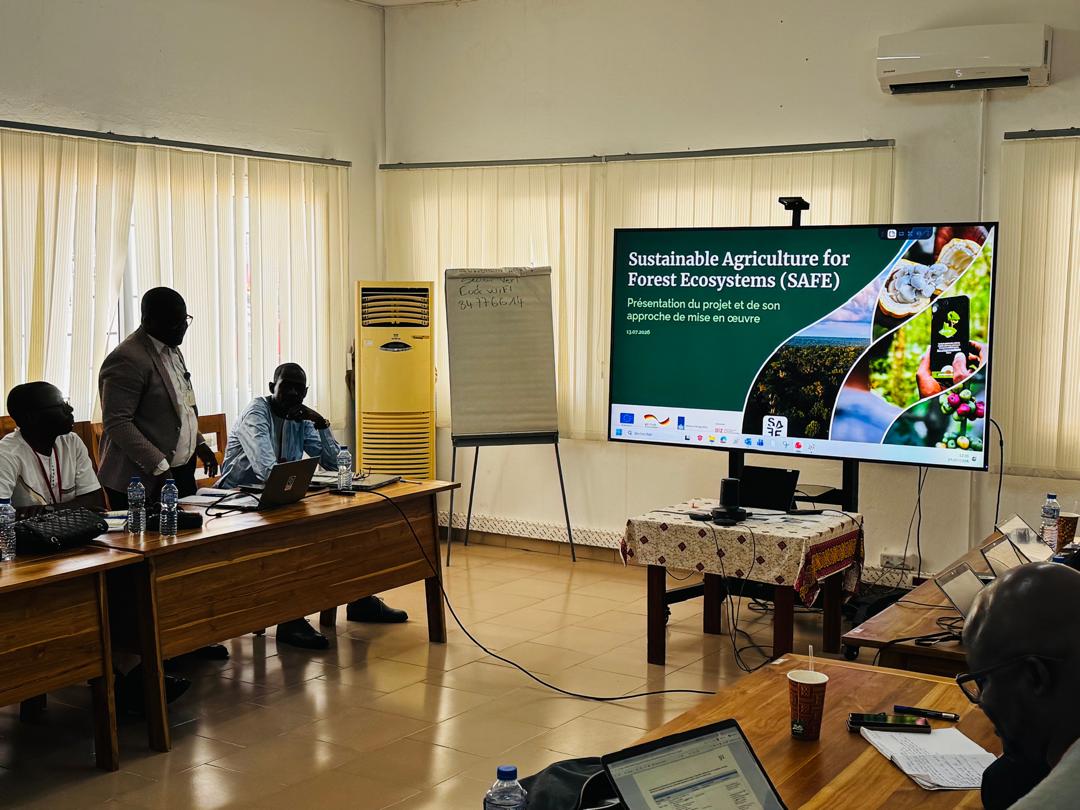
From July 27 to 29, 2026, KACCO participated in an exchange visit in Togo focused on contract farming. The visit was organized within the framework of the Sustainable Agriculture Support Project in Forest Ecosystems (SAFE) in the Democratic Republic of Congo and the Agricultural Entrepreneurship Programme (PEA) in Chad, with the support of the GIZ ProComp project in Togo.
The mission aimed to facilitate the sharing of experiences and good practices related to the implementation, operationalization and institutionalization of the Contract Farming (CF) business model. It also enabled participants to identify success factors and approaches that could potentially be replicated and adapted to their own contexts.
An Immersion into the Togolese Experience
Over three days, delegations from the Democratic Republic of Congo, Chad and Togo shared their respective experiences in agricultural sectors, support projects and programmes, as well as mechanisms developed to strengthen agricultural value chains.
The first day provided an opportunity to learn about Togo's experience in implementing contract farming, its achievements, challenges and lessons learned. Contract farming was presented as a tool capable of strengthening both the competitiveness and sustainability of agricultural value chains.
For KACCO, this experience is particularly relevant in the current context of developing new agricultural activities and seeking mechanisms capable of securing supply, markets and producer incomes.
Two Particularly Instructive Business Models
The second day focused on two Togolese companies that have developed contract farming models: Label d’Or in the shea value chain and SITRAPAT in the maize value chain.
Label d’Or: Investing Beyond the Purchase of Agricultural Products
The experience of Label d’Or demonstrates that a contractual relationship can go far beyond a simple purchasing agreement.
Through its partnership with the Dihéza cooperative, the company is involved in the processing of shea nuts and supports or facilitates several investments and services, including equipment, drying and storage infrastructure, transportation, crushing equipment, protective equipment and certain aspects related to certification. The products are intended in particular for European and American markets.
Lesson for KACCO
A sustainable commercial relationship with producers should gradually evolve into an economic partnership in which the company or cooperative contributes to addressing the constraints that prevent producers from becoming more competitive, including equipment, quality, certification, storage, transportation, financing and market access.
SITRAPAT: Securing Production and Markets Simultaneously
SITRAPAT's model is also particularly interesting. The company works with maize producers and processes the production into different products, including flour for human consumption and grits intended for the brewing industry. The company currently has 34 employees and works with 70 agricultural cooperatives.
Its agreement with the Affem maize producers' group is based on several structuring mechanisms: a five-year framework agreement with exclusivity over contracted plots, the gradual introduction of hybrid varieties, the establishment of farmer field schools, training and advisory support, as well as facilitated access to credit, insurance and equipment. The price is aligned with the market price, with a premium ranging from 5% to 20%.
Lesson for KACCO
Contract farming can become a genuine mechanism for securing a value chain when it simultaneously integrates production, technical support, financing, inputs, quality, market access and transparent pricing mechanisms.
Key Lessons Learned by KACCO
1. Moving from a Purchasing Relationship to a Genuine Partnership
Contract farming should not be understood merely as a purchasing contract between producers and buyers. It can become a partnership mechanism in which each party assumes clearly defined responsibilities and contributes to value creation.
For KACCO, this opens interesting opportunities to strengthen its relationships with producers and buyers through more structured contractual arrangements.
2. Securing the Market Before Increasing Production
The SITRAPAT experience demonstrates the importance of establishing sufficiently strong commercial relationships to give producers greater visibility regarding market opportunities.
For KACCO, this approach can be particularly useful in the development of new agricultural commodities and in the diversification of agricultural activities around coffee and other products.
3. Putting Producer Services at the Heart of Contract Farming
The models observed demonstrate that producer competitiveness depends heavily on access to equipment, inputs, training, financing, insurance, infrastructure and technical services.
Contract farming should therefore be designed as a package of services rather than simply as a legal document.
4. Investing in Quality, Certification and Processing
The Label d’Or experience also demonstrates that a commercial partnership can directly contribute to improving quality, certification, infrastructure and equipment required to access international markets.
For a cooperative such as KACCO, which is already engaged in Arabica coffee exports, this lesson reinforces the importance of continued investment in quality, traceability, compliance and local processing.
5. Building Balanced and Transparent Contracts
The SITRAPAT agreement includes a five-year duration, clearly defined commitments from the parties and a market-linked pricing mechanism with a premium.
This experience demonstrates that a good agricultural contract should provide producers with visibility while ensuring that the company has security of supply.
For KACCO, contract farming should therefore seek to balance secure markets, fair producer remuneration and the economic sustainability of the cooperative.
A Skills Network to Support Scaling Up
Another important lesson from the mission was the establishment in Togo of a network of Contract Farming coaches.
The network aims to support the implementation, scaling and sustainability of contract farming through advisory services, capacity building and support to different actors across agricultural value chains.
For KACCO, this approach demonstrates the importance of having the necessary expertise to sustainably support producers and partners in the design, negotiation, implementation and monitoring of agricultural contracts.
From the Togolese Experience to Action in Kalehe
Beyond visits and exchanges, the challenge for KACCO is now to transform the lessons learned from this mission into concrete actions.
The experiences observed in Togo can inspire KACCO in structuring future contract farming models with its members and commercial partners, particularly as it diversifies its agricultural activities.
This approach could help better organize production, secure markets, facilitate access to inputs and financial services, improve quality and create greater value for producers.
Learning from Africa to Build Solutions Adapted to Kalehe
The mission also demonstrated the importance of cooperation and peer-to-peer learning among African actors. The different delegations were able to compare their realities, share experiences and identify practices that could be adapted to their respective contexts.
During the closing session, the ProComp Programme reaffirmed the importance of synergy, experience sharing and resource pooling among projects and programmes. The mission therefore laid the foundations for future collaborations in support of a more competitive, inclusive and sustainable agriculture.
An Experience Opening New Perspectives for KACCO
For KACCO, the visit to Togo was therefore much more than a learning trip. It provided an opportunity to deepen its reflection on business models capable of better connecting producers to markets, securing investments and creating greater value in rural areas.
From contract farming to processing, from access to services to market expansion, the Togolese experience offers KACCO concrete avenues for continuing the professionalization of its members and building stronger, more inclusive and sustainable agricultural value chains.
KACCO would like to thank the organizers, GIZ and the ProComp project for this valuable exchange opportunity, as well as all the Togolese stakeholders for their warm welcome, availability and willingness to share their experiences.
The learning continues. The objective remains the same: to transform African experiences into concrete solutions that can sustainably improve the living conditions and incomes of producers in Kalehe.